
- Alan Watts: Background and Influence
- Top 50 Alan Watts Quotes on Life
- 1. “Trying to define yourself is like trying to bite your own teeth.”
- 2. “This is the real secret of life—to be completely engaged with what you are doing in the here and now.”
- 3. “You are an aperture through which the universe is looking at and exploring itself.”
- 4. “Muddy water is best cleared by leaving it alone.”
- 5. “Stop measuring days by degree of productivity and start experiencing them by degree of presence.”
- 6. “You don’t look out there for God, something in the sky; you look in you.”
- 7. “If you say that getting the money is the most important thing, you will spend your life completely wasting your time.”
- 8. “The only way to make sense out of change is to plunge into it, move with it, and join the dance.”
- 9. “We cannot be more sensitive to pleasure without being more sensitive to pain.”
- 10. “No valid plans for the future can be made by those who have no capacity for living now.”
- 11. “Trying to control the future is like trying to take the master carpenters’ place.”
- 12. “It’s better to have a short life that is full of what you like doing than a long life spent in a miserable way.”
- 13. “The menu is not the meal.”
- 14. “Man suffers only because he takes seriously what the gods made for fun.”
- 15. “You are that vast thing that you see far, far off with great telescopes.”
- 16. “The more a thing tends to be permanent, the more it tends to be lifeless.”
- 17. “You are an illusion, and so am I—but illusions are not nothing.”
- 18. “The ego is nothing other than the focus of conscious attention.”
- 19. “Meditation is the discovery that the point of life is always arrived at in the immediate moment.”
- 20. “We do not ‘come into’ this world; we come out of it, as leaves from a tree.”
- 21. “You find out that the universe is just a Rorschach inkblot.”
- 22. “Every intelligent individual wants to know what makes him tick.”
- 23. “Things are as they are. Looking out into the universe at night, we make no comparisons between right and wrong stars.”
- 24. “People become concerned with being more humble than other people.”
- 25. “When we attempt to exercise power or control over someone else, we cannot avoid giving that person the very same power or control over us.”
- 26. “Problems that remain persistently insoluble should always be suspected as questions asked in the wrong way.”
- 27. “Everybody is fundamentally the ultimate reality—not God in the kingly sense, but God in the sense of being the self—the deep down basic whatever there is.”
- 28. “We cannot be more sensitive to pleasure without being more sensitive to pain.”
- 29. “Zen does not confuse spirituality with thinking about God while one is peeling potatoes. Zen spirituality is just to peel the potatoes.”
- 30. “The more we struggle for life, as pleasure, the more we are actually killing what we love.”
- 31. “To have faith is to trust yourself to the water.”
- 32. “You can only be on the inside of what you can take for granted.”
- 33. “Nature is purposeless. Yet this purposelessness is incredibly intelligent.”
- 34. “If we get into ourselves, and we have no baggage to take along, we don’t need to take a thing.”
- 35. “Peace can be made only by those who are peaceful.”
- 36. “What we see as death, empty space, or nothingness is only the trough between the crests of this endlessly waving ocean.”
- 37. “There is no formula for generating the authentic warmth of love. It cannot be copied.”
- 38. “Never pretend to a love which you do not actually feel, for love is not ours to command.”
- 39. “The meaning of life is just to be alive.”
- 40. “We have run into a culture so fixated on the future that we fail to see no one has ever actually lived there.”
- 41. “Society is our extended mind and body.”
- 42. “When we watch clouds, we don’t complain: ‘Give me a square cloud!’ We just let them float by.”
- 43. “We do not dance to reach a certain point on the floor but simply to dance.”
- 44. “Life is not a problem to be solved, but an experience to be had.”
- 45. “Your body does not end at your fingertips.”
- 46. “If you cannot trust yourself, you cannot even trust your mistrust of yourself.”
- 47. “Better to have a short life that is full of what you like doing than a long life spent in a miserable way.”
- 48. “Stop delaying real happiness by focusing on illusions of future.”
- 49. “We seldom realize, for example, that our most private thoughts and emotions are not actually our own.”
- 50. “Wake up! If you knew for certain you had a short time to live, you might not waste it in avoidance.”
- Major Themes in Alan Watts’s Philosophy
- Practical Applications & Reflection
- Conclusion
Alan Watts: Background and Influence
Alan Wilson Watts was born in Kent, England, in 1915. As a teenager, he developed a fascination with the Far East—poring over texts on Zen Buddhism and Eastern philosophy. After relocating to the United States, he became an Episcopal priest but eventually left the clergy to focus on a more interfaith, philosophical approach. His diverse experiences shaped the open-minded lens through which he interpreted Eastern concepts for Western audiences.
Watts authored more than 25 books, among them The Wisdom of Insecurity, The Book on the Taboo Against Knowing Who You Are, and Cloud-Hidden, Whereabouts Unknown. He also delivered countless lectures—many of which live on today through audio recordings and online videos. His signature style combined a relaxed, almost mischievous humor with profound philosophical depth.
One of Watts’s enduring contributions is demystifying complex spiritual topics, like the nature of consciousness and the interplay of self and universe. Rather than presenting spirituality as dogma, he invited readers and listeners to question assumptions, focus on the now, and accept the flowing, impermanent nature of reality. This approach resonates strongly with those in search of psychological and spiritual well-being. Consequently, Alan Watts quotes on life remain widely shared—popping up on social media platforms, blogs, podcasts, and mindfulness retreats alike.
Top 50 Alan Watts Quotes on Life
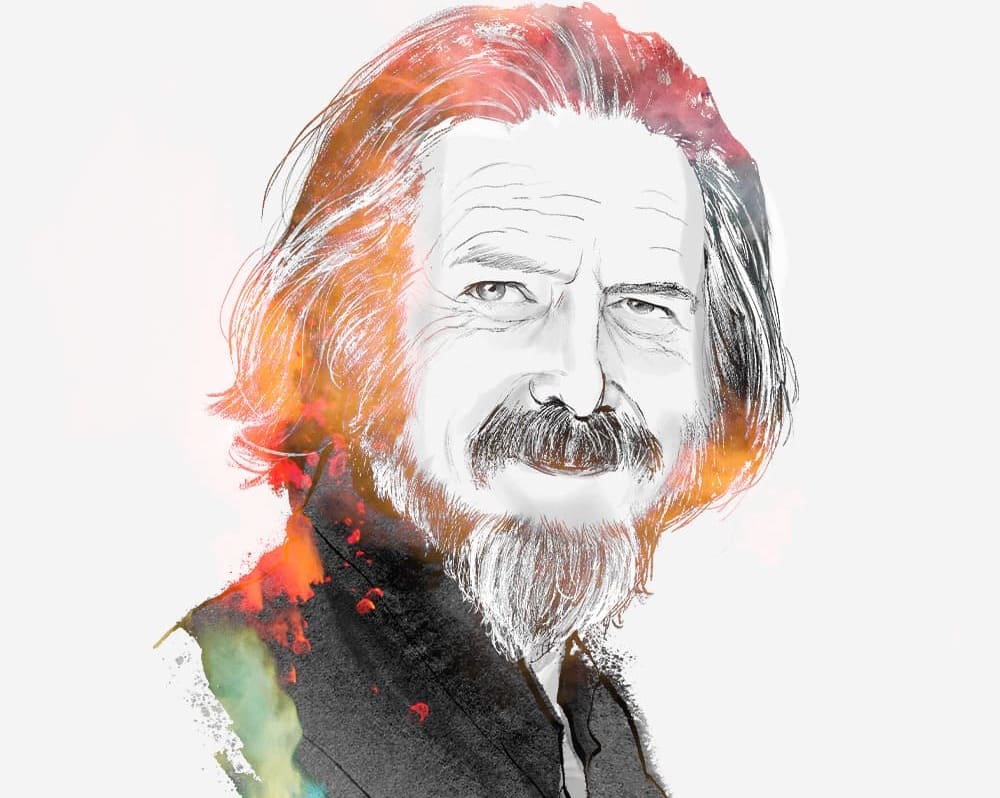
Below is a curated list of 50 of the best Alan Watts quotes about life. Each quote is brief, followed by context and a short commentary. By examining these passages, you’ll uncover key aspects of Watts’s philosophy and how they can guide us toward greater clarity and peace.
1. “Trying to define yourself is like trying to bite your own teeth.”
- Source/Context: From his talks on the concept of the self.
- Commentary: Watts often underscored the futility of a rigid self-definition. The “self” is not a static entity but a dynamic, ever-evolving process.
2. “This is the real secret of life—to be completely engaged with what you are doing in the here and now.”
- Source/Context: Lecture on mindfulness and presence.
- Commentary: Reminds us that fulfillment arises when we immerse ourselves wholly in the present, without clinging to past regrets or future anxieties.
3. “You are an aperture through which the universe is looking at and exploring itself.”
- Source/Context: The Book on the Taboo Against Knowing Who You Are.
- Commentary: Aligning with many Eastern traditions, Watts viewed individuals as expressions of a universal consciousness, not isolated entities.
4. “Muddy water is best cleared by leaving it alone.”
- Source/Context: The Way of Zen.
- Commentary: Suggests that overthinking or forced action can create more confusion. Sometimes, allowing the mind to settle naturally is the wisest move.
5. “Stop measuring days by degree of productivity and start experiencing them by degree of presence.”
- Source/Context: Paraphrased from lectures discussing the Western obsession with achievement.
- Commentary: Encourages us to see a day’s worth not by how much we accomplish but by how deeply we engage with our experiences.
6. “You don’t look out there for God, something in the sky; you look in you.”
- Source/Context: Discussions on the nature of the divine in Eastern traditions.
- Commentary: Watts flips traditional theology, suggesting divinity or ultimate reality is inherently accessible within oneself.
7. “If you say that getting the money is the most important thing, you will spend your life completely wasting your time.”
- Source/Context: Lecture on life purpose and career choices.
- Commentary: A critique of materialism, highlighting that a life fixated on money often overlooks deeper fulfillment and joy.
8. “The only way to make sense out of change is to plunge into it, move with it, and join the dance.”
- Source/Context: The Wisdom of Insecurity.
- Commentary: Emphasizes change as a constant and encourages fluid adaptation—like dancing—rather than rigid resistance.
9. “We cannot be more sensitive to pleasure without being more sensitive to pain.”
- Source/Context: Explores dualities in Watts’s essays on human emotions.
- Commentary: Joy and suffering exist on the same continuum. Heightened sensitivity to life’s beauty also increases our capacity to feel pain.
10. “No valid plans for the future can be made by those who have no capacity for living now.”
- Source/Context: Lecture on time, presence, and future-building.
- Commentary: Genuine foresight emerges from a grounded, mindful relationship with the present moment.
11. “Trying to control the future is like trying to take the master carpenters’ place.”
- Source/Context: An allusion to Taoist wisdom in lectures referencing Zhuangzi and Lao Tzu.
- Commentary: Suggests humility before the natural flow of life. Attempts to overly engineer outcomes often backfire.
12. “It’s better to have a short life that is full of what you like doing than a long life spent in a miserable way.”
- Source/Context: Lecture on meaningful livelihood.
- Commentary: Encourages prioritizing passion over security. Alan Watts quotes frequently champion living authentically, even if that path is less guaranteed.
13. “The menu is not the meal.”
- Source/Context: Warning against confusing concepts with reality, used in multiple talks.
- Commentary: Symbolizes how descriptions, labels, or theories about life aren’t the same as direct experience.
14. “Man suffers only because he takes seriously what the gods made for fun.”
- Source/Context: In My Own Way.
- Commentary: Advocates a playful view of existence, suggesting we cause suffering by clinging too tightly to rigid interpretations of life events.
15. “You are that vast thing that you see far, far off with great telescopes.”
- Source/Context: Lecture referencing the oneness of observer and observed.
- Commentary: Illustrates the non-dual concept: we’re not separate from the universe we study; we’re part of it.
16. “The more a thing tends to be permanent, the more it tends to be lifeless.”
- Source/Context: Reflections on impermanence in The Wisdom of Insecurity.
- Commentary: Arguing that true vitality lies in constant change. Excessive desire for permanence can stifle growth.
17. “You are an illusion, and so am I—but illusions are not nothing.”
- Source/Context: Notes on the self, bridging Buddhist teachings on “no-self.”
- Commentary: A playful paradox. Although the separate ego is ultimately a construct, it still has its own experiential reality.
18. “The ego is nothing other than the focus of conscious attention.”
- Source/Context: Explaining the nature of the ego in his talks on Zen.
- Commentary: Challenges the notion of a solid self, proposing that the ‘I’ arises in the spotlight of awareness.
19. “Meditation is the discovery that the point of life is always arrived at in the immediate moment.”
- Source/Context: Commentary on Buddhist meditation practices.
- Commentary: Points to why mindfulness is vital—life’s richness is found in the now, not in fleeting mental abstractions.
20. “We do not ‘come into’ this world; we come out of it, as leaves from a tree.”
- Source/Context: The Book on the Taboo Against Knowing Who You Are.
- Commentary: Affirms our inseparable link to nature, contrasting the typical Western view that we’re outsiders in the universe.
21. “You find out that the universe is just a Rorschach inkblot.”
- Source/Context: Lectures about perception and meaning-making.
- Commentary: Suggests that reality takes shape partly through our interpretative lens; we project our inner world onto what we observe.
22. “Every intelligent individual wants to know what makes him tick.”
- Source/Context: Encouragement toward self-inquiry found in various essays.
- Commentary: Motives, fears, and desires often run subconsciously. Conscious exploration fosters growth and understanding.
23. “Things are as they are. Looking out into the universe at night, we make no comparisons between right and wrong stars.”
- Source/Context: The Wisdom of Insecurity.
- Commentary: Reveals that much suffering arises from human judgments of “good” or “bad.” Nature itself simply is.
24. “People become concerned with being more humble than other people.”
- Source/Context: Critiques of spiritual pride in certain religious or philosophical circles.
- Commentary: Points out how even humility can become an ego trap if wielded competitively.
25. “When we attempt to exercise power or control over someone else, we cannot avoid giving that person the very same power or control over us.”
- Source/Context: Explorations of Taoist views on control and surrender.
- Commentary: Explains the relational dynamics of power: the more you push, the more pushback you invite.
26. “Problems that remain persistently insoluble should always be suspected as questions asked in the wrong way.”
- Source/Context: The Book: On the Taboo Against Knowing Who You Are.
- Commentary: Encourages reevaluating assumptions behind our questions. Often, the issue is the framing, not the lack of solutions.
27. “Everybody is fundamentally the ultimate reality—not God in the kingly sense, but God in the sense of being the self—the deep down basic whatever there is.”
- Source/Context: Lecture on divine identity in each individual.
- Commentary: Suggests we each carry an essence that is universal, defying hierarchical conceptions of God.
28. “We cannot be more sensitive to pleasure without being more sensitive to pain.”
- Source/Context: Reiterated in many speeches on dualistic nature of human emotions.
- Commentary: Accepting life’s delights necessitates acceptance of potential sorrow. The two experiences are interwoven.
29. “Zen does not confuse spirituality with thinking about God while one is peeling potatoes. Zen spirituality is just to peel the potatoes.”
- Source/Context: The Way of Zen.
- Commentary: Illustrates Zen’s emphasis on total engagement with the task at hand—simple and direct awareness.
30. “The more we struggle for life, as pleasure, the more we are actually killing what we love.”
- Source/Context: Critique on desperate clinging to happiness.
- Commentary: Pursuing pleasure too aggressively can paradoxically destroy the conditions for genuine joy.
31. “To have faith is to trust yourself to the water.”
- Source/Context: Metaphor from lectures on surrender and letting go.
- Commentary: Compare it to swimming: you don’t float by tensing up; you float by relaxing into the water.
32. “You can only be on the inside of what you can take for granted.”
- Source/Context: Observations about comfort zones.
- Commentary: Unless we question the assumptions of our environment, we remain enveloped by them, often without realizing alternatives.
33. “Nature is purposeless. Yet this purposelessness is incredibly intelligent.”
- Source/Context: Reflections on Taoism and natural order.
- Commentary: Suggests that while nature may not adhere to human-defined goals, it operates with an inherent, adaptive wisdom.
34. “If we get into ourselves, and we have no baggage to take along, we don’t need to take a thing.”
- Source/Context: Lecture about self-reflection and traveling light—materially and psychologically.
- Commentary: Conveys that shedding mental burdens can lead to true freedom and clarity.
35. “Peace can be made only by those who are peaceful.”
- Source/Context: A viewpoint on conflict resolution.
- Commentary: Real change arises from embodying the state we wish to spread, be it peace, love, or wisdom.
36. “What we see as death, empty space, or nothingness is only the trough between the crests of this endlessly waving ocean.”
- Source/Context: Cloud-Hidden, Whereabouts Unknown.
- Commentary: Highlights his cyclical view of existence—death or void is part of a continuous process, not an absolute end.
37. “There is no formula for generating the authentic warmth of love. It cannot be copied.”
- Source/Context: Explorations of relationships and genuine emotional connection.
- Commentary: True love arises spontaneously; attempts to force or replicate it often fail.
38. “Never pretend to a love which you do not actually feel, for love is not ours to command.”
- Source/Context: Related talk on authenticity in emotions.
- Commentary: Warns against inauthentic declarations of affection. Real love transcends conscious will or manipulation.
39. “The meaning of life is just to be alive.”
- Source/Context: Lecture on living in the present without constant intellectualization.
- Commentary: A succinct conclusion that life’s “meaning” is not something to be solved or found, but rather experienced.
40. “We have run into a culture so fixated on the future that we fail to see no one has ever actually lived there.”
- Source/Context: Critique of modern society’s forward-thinking obsession.
- Commentary: Emphasizes presence; the future is always hypothetical, so living for it robs us of the reality of now.
41. “Society is our extended mind and body.”
- Source/Context: Concepts bridging individual consciousness with collective culture.
- Commentary: Watts saw us not as isolated monads but deeply integrated with the larger social organism.
42. “When we watch clouds, we don’t complain: ‘Give me a square cloud!’ We just let them float by.”
- Source/Context: Lecture using whimsical metaphors.
- Commentary: Encourages acceptance of nature as it is—non-judgmental observation, which we might extend to life’s events.
43. “We do not dance to reach a certain point on the floor but simply to dance.”
- Source/Context: The Journey vs. The Destination talk.
- Commentary: Perfectly encapsulates the “journey over destination” principle. Life’s purpose is found in the act, not the outcome.
44. “Life is not a problem to be solved, but an experience to be had.”
- Source/Context: Lecture on reframing life’s challenges.
- Commentary: Argues that over-intellectualizing existence as a “problem” reduces its richness. Instead, immerse yourself in living.
45. “Your body does not end at your fingertips.”
- Source/Context: Philosophical explorations of boundaries.
- Commentary: We’re interconnected with our environment (oxygen, sunlight, etc.), hinting that separation is largely conceptual.
46. “If you cannot trust yourself, you cannot even trust your mistrust of yourself.”
- Source/Context: Reflections on self-doubt and circular reasoning.
- Commentary: Emphasizes the paradox—an utter lack of self-trust leads to an intellectual dead end, implying a need to cultivate basic self-confidence.
47. “Better to have a short life that is full of what you like doing than a long life spent in a miserable way.”
- Source/Context: Reiterates earlier perspectives on vocational meaning.
- Commentary: Reemphasizes risk-taking in pursuit of genuine passion, as opposed to drawn-out dissatisfaction.
48. “Stop delaying real happiness by focusing on illusions of future.”
- Source/Context: Summation of his calls to present living.
- Commentary: Another variation on the theme that waiting for future conditions to align perfectly can postpone genuine joy indefinitely.
49. “We seldom realize, for example, that our most private thoughts and emotions are not actually our own.”
- Source/Context: Psychotherapy East & West.
- Commentary: Points to the influence of culture, upbringing, and collective unconscious on our inner life—suggesting a “shared mind.”
50. “Wake up! If you knew for certain you had a short time to live, you might not waste it in avoidance.”
- Source/Context: Common rallying cry in his lectures about facing reality.
- Commentary: The call to awareness: life’s fleeting nature should motivate us to engage fully and authentically with each moment.
Major Themes in Alan Watts’s Philosophy
Reading through these Alan Watts quotes on life, certain themes appear repeatedly:
- Illusion of Separateness: Watts emphasized that much suffering arises from believing we exist as isolated selves detached from the cosmos. Instead, we’re deeply enmeshed in a universal process.
- Mindfulness and Presence: A strong Zen influence flows through his works, underscoring that being fully present in the moment is key to spiritual insight.
- Acceptance of Change: Both physical existence and psychological states are in flux. Resistance to impermanence leads to suffering, whereas embracing the dance of change invites harmony.
- Playful Approach to Existence: Watts often used humor and paradox to encourage a more lighthearted engagement with life, viewing it as a grand play or dance rather than a puzzle to crack.
- Critique of Over-Seriousness: He challenged the Western habit of equating seriousness with virtue. For Watts, excessive seriousness blinds us to the cosmic joke and the innate delight in simply being.
By consistently returning to these ideas—blending influences from Taoism, Buddhism, and Jungian psychology—Watts offered a path for those yearning for a more spacious, intuitive, and less anxious relationship to life’s complexities.
Practical Applications & Reflection
If these best Alan Watts quotes resonate with you, here are some ways to integrate his insights into everyday life:
- Daily Mindfulness Practice: Whether through brief meditation or focused breathing, cultivate a habit of returning to the present moment throughout your day. Notice when you get stuck in regrets or future worries, and gently bring attention back to now.
- Embrace Flow: Instead of rigidly planning every detail, allow space for spontaneity. Trust that letting go can reveal new possibilities, whether at work or in personal relationships.
- Reframe Challenges: When confronting difficulties, view them as part of life’s continuous dance. Acknowledge the tension between pain and pleasure—both valid aspects of growth.
- Observe Without Judgment: Practice simply watching your thoughts, emotions, and surroundings without rushing to label them good or bad. This fosters clarity and reduces anxiety.
- Reflect on Interconnection: Consider how your life depends on countless factors—the farmers who grow your food, the environment supplying oxygen, the people who teach you. Recognizing these interrelations often evokes gratitude and humility.
By consistently applying these principles, you may find yourself less weighed down by fear, guilt, or regret. Instead, you’ll nurture a sense of wonder, acceptance, and playful curiosity—the hallmarks of Watts’s visionary outlook.
Conclusion
The alan watts quotes on life assembled here highlight the remarkable clarity and range of Alan Watts’s contributions. From the fluid nature of identity to the wisdom in accepting life’s endless flux, these passages collectively point us toward a more mindful, spontaneous, and connected way of existing. In a society that often prioritizes constant achievement and rigid definitions, Watts reminds us to pause, breathe, and remember that each moment is an invitation to explore the profound miracle of being alive.
Though Alan Watts passed away in 1973, his legacy remains vibrant—his recorded lectures, books, and essays continue to engage readers, scholars, and spiritual seekers. His warmth, wit, and eagerness to reconcile East–West worldviews ensure that Alan Watts quotes endure as guideposts for anyone yearning to live with greater wisdom and authenticity. Indeed, as he himself might phrase it: true learning happens when we realize we already are what we seek—if only we allow ourselves to simply be.
Whether you adopt one of his recommendations into your daily routine or find solace in the knowledge that you’re an integral part of an ever-evolving universe, Watts’s teachings can catalyze transformation. Reflect on these best Alan Watts quotes whenever you feel the push and pull of life’s demands, or whenever you forget that the greatest treasures of existence are found in moments of present awareness, playful curiosity, and open-hearted surrender to the grand “dance” of being.